
Uncategorized
THC Vape International Shipping: Risks, Laws & Safer Choices
THC Vape International Shipping: Risks, Laws & Safer Choices
THC vape international shipping sits at the sharpest edge of modern cannabis e-commerce: you can browse a full catalogue of premium cartridges and check out in minutes, yet getting those same products across an international border is an entirely different matter. The gap between what you can buy online and what you can legally import is one of the most misunderstood aspects of the contemporary cannabis market, and the consequences of getting it wrong are serious. This article covers the full picture: the legal framework across key jurisdictions, how customs agencies actually work, what major carriers will and will not accept, the real penalties when things go wrong, and what responsible discreet fulfilment genuinely looks like.
Why no country legally permits THC vape imports
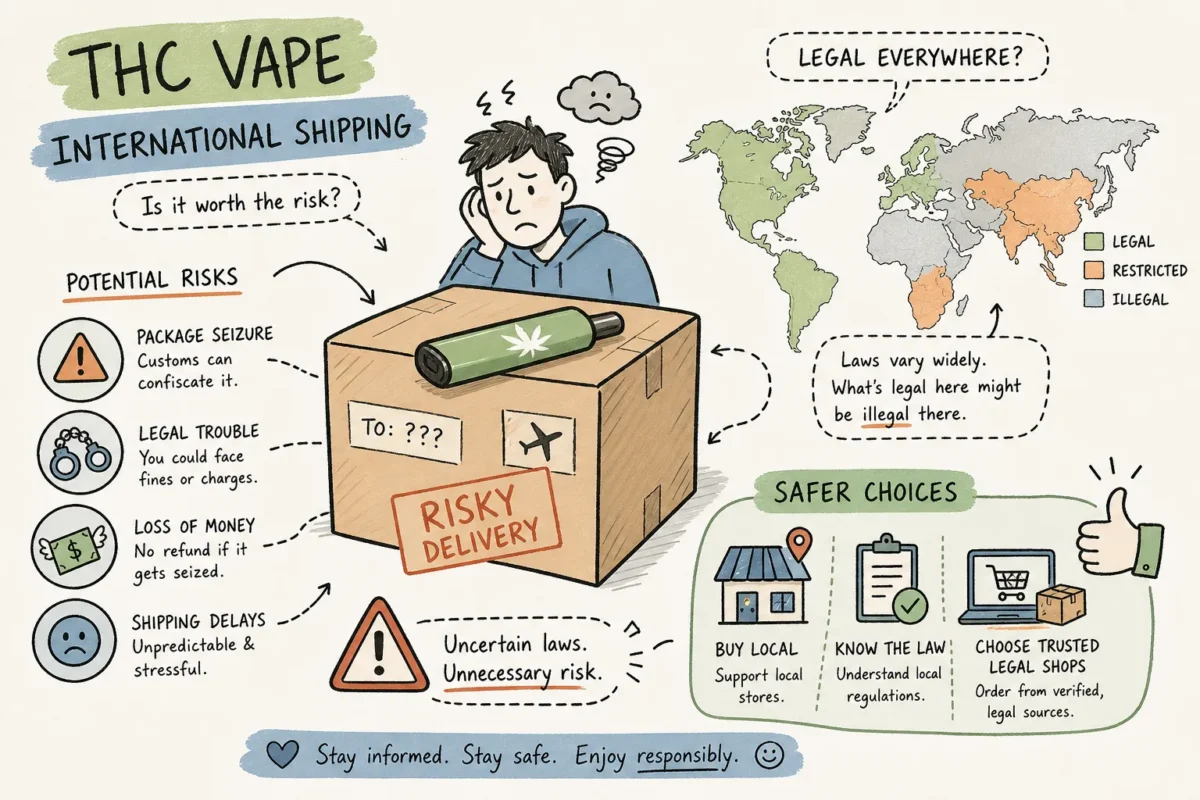
This is the foundational reality that underpins everything else in this article: not a single country in the world explicitly permits the recreational importation of THC vape cartridges across an international border. It does not matter what is permitted domestically. Canada has full recreational legalisation and still bans international cannabis imports outright. Uruguay is the same. The principle is consistent across virtually every jurisdiction on earth, and it is grounded in the 1988 UN Drug Convention, which all EU member states have implemented into national law.
The UK, France, Germany and the rest of Europe
In the United Kingdom, THC is a Class B controlled substance under the Misuse of Drugs Act 1971. Importing it without a licence from the Home Office is a criminal offence, not a technicality or a grey area. Germany’s landmark domestic cannabis reforms in 2024 received extensive media coverage, but those reforms changed absolutely nothing about cross-border law: importing THC products into Germany remains a serious criminal offence under the BtMG. France operates with zero tolerance and imposes fines and imprisonment for possession at the border. Across EU member states, the core prohibition is consistent: domestic policy and cross-border law are entirely separate, and the latter has not changed, even where individual member states vary in their domestic thresholds and sentencing approaches.
Countries where even a trace amount is a criminal matter
Several jurisdictions go further still, applying zero-tolerance rules that extend even to CBD products containing detectable THC. Japan, Singapore, and the UAE treat possession of any THC-containing product as a serious criminal matter, regardless of origin or quantity. Norway, Sweden, Iceland, and several other Nordic and Balkan states require CBD products to contain literally 0.0% THC; any detectable trace is banned. Australia permits the importation of medicinal cannabis vaping devices only when the importer holds a formal licence from the Office of Drug Control. For general consumers, the answer in all these markets is the same: prohibited.
Why the hardware is not the problem, but what’s inside always is
There is an important distinction worth understanding here. Vape hardware, specifically the battery and device components, is often permitted in carry-on luggage because of lithium battery regulations. The THC oil inside the cartridge is a controlled substance and is treated entirely separately. Paraphernalia laws complicate things further: in many countries, a vaporiser designed for use with THC concentrates can be treated as drug paraphernalia even if it contains only residue. The device may clear one checkpoint; the legal liability attached to it does not.
How customs detect THC vape international shipping
Most people assume customs uses sophisticated chemical scanners that can identify THC on sight. The reality is more nuanced, and understanding it helps explain why detection is both less predictable and more multi-layered than a single technology.
What X-ray machines can and cannot do
X-ray scanners identify density and shape, not chemical compounds. THC oil, CBD oil, and nicotine e-liquid are indistinguishable on a scanner: all appear as similar-density liquids in a cartridge. What an officer can see on screen is the vape device itself, the battery, coil, and cartridge housing. The THC content inside is invisible to the machine. This is not a loophole; it simply explains why the next layers of detection exist and why they are often more consequential than the initial scan.
What actually triggers an inspection
Real red flags include visible cannabis branding on packaging, multiple devices in a single parcel suggesting commercial rather than personal intent, damaged cartridges with leaked oil, and distinctive odour. Sniffer dogs trained to detect THC residue are deployed at high-risk checkpoints; studies from veterinary and law enforcement sources confirm they can detect cannabis scent even through sealed packaging, with olfactory sensitivity orders of magnitude beyond human capability. Risk-based profiling of origin countries and freight routes also plays a significant role: parcels from jurisdictions with known cannabis markets receive additional scrutiny. Behavioural cues and random sampling complement this at postal and courier sorting facilities.
Major carrier policies: a straightforward summary
UPS, DHL, PostNL, and Royal Mail all prohibit THC vapes without exception. UPS explicitly bans all hemp cannabinoid liquid products intended for vaporisation, regardless of THC content. The PACT Act in the United States compels USPS to ban all electronic nicotine delivery systems, and major international carriers, including UPS, FedEx, and DHL, have adopted comparable restrictions in practice. DHL enforces a comprehensive ban on all ENDS products, covering nicotine, cannabis, CBD, and hemp vaping products. A parcel containing THC vapes that enters any of these systems faces rejection, seizure, or destruction, and the carrier may refer the matter to law enforcement.
UK sentences: from confiscation to years in prison
Under the Misuse of Drugs Act 1971 combined with Section 170 of the Customs and Excise Management Act 1979, importing a Class B controlled substance such as cannabis or THC carries a maximum of 14 years imprisonment and an unlimited fine. Personal possession at the border can still result in up to 5 years. Cases reported in 2024 involved custodial sentences for individuals importing cannabis and THC vapes ranging from 21 months to 5 years, depending on each person’s role in the operation. The “personal use” defence carries almost no weight at customs: Border Force is active, enforcement at postal sorting facilities is systematic, and seizure is immediate regardless of stated intent.
How THC Vape Europe approaches worldwide delivery from the Netherlands
THC Vape Europe is based in the Netherlands, a country with an established cannabis framework and sophisticated logistics infrastructure. The shop describes its fulfilment model as built around double vacuum-sealed packaging designed to reduce exterior odour and remove identifying features from the outside of the parcel, alongside privacy-focused checkout that aims to minimise the retention of buyer information. Products include lab-tested options with potency and terpene documentation. A legal, discreet order differs from an illegal self-arranged shipment in the operator behind it, the origin country, and the infrastructure applied, not merely the product itself.
The informed choice is always the better one
THC vape international shipping sits in one of the most legally complex corners of modern e-commerce. The rules are consistent across nearly every major jurisdiction: no personal use exemption exists at borders, customs and carrier enforcement is active and systematic, and penalties scale quickly with perceived commercial intent. Understanding how detection actually works, what carriers do with flagged parcels, and where the real legal exposure sits gives you a clearer picture than most publicly available information provides.
If you are weighing your options, remember that THC vape international shipping is fraught with legal and logistical risk. For those serious about accessing premium THC products, the smarter path is choosing a shop that has built its fulfilment model around discretion and transparency from the ground up. THC Vape Europe describes exactly that approach: products with lab documentation, shipped from the Netherlands with vacuum-sealed packaging and privacy-focused infrastructure at every step. That is a very different proposition from rolling the dice with a self-arranged international shipment.
